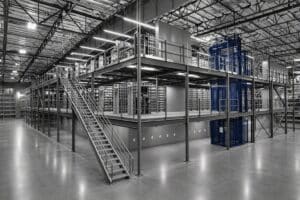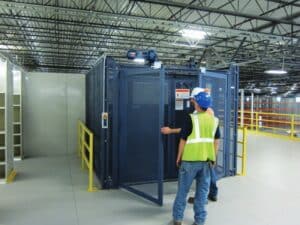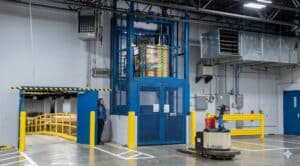
Investing in a Vertical Reciprocating Conveyor (VRC) can revolutionize material handling in your facility, enhancing safety, efficiency, and productivity. As the founder and leading manufacturer of VRCs, PFlow Industries has spent decades engineering and manufacturing custom material lifting equipment for virtually every industry. The PFlow M Series Mechanical VRC is a versatile two-post mechanical lift engineered to handle the rigors of continuous operation and high-capacity applications. From palletized goods to heavy machinery and irregular sized and bulky loads, the M Series is designed to perform reliably in demanding operations. Its customizable design makes it the ultimate vertical lifting solution for facilities requiring smooth, efficient, and heavy-duty material handling. Like all PFlow VRCs, no two M Series lifts are exactly the same.
Because every PFlow M Series mechanical vertical lift is engineered to order, pricing can vary widely based on each project’s requirements. Factors like travel height, platform size, load capacity, optional safety features, and installation environment all impact the final investment. Rather than publishing misleading “ballpark” pricing, PFlow focuses on transparency around the factors that most directly influence total equipment cost.
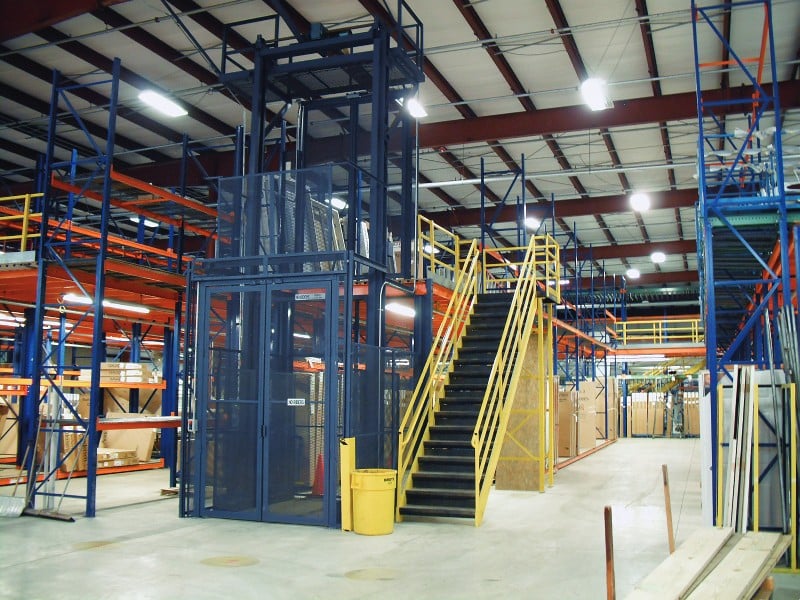
Factors That Impact the Cost of the M Series Mechanical VRC
The price of an M Series VRC depends on the unique requirements of your operation. Below are the primary factors influencing cost:
1. Size and Configuration
The size of the carriage and the vertical travel height are customized to meet your facility and production requirements and directly affect the cost. PFlow engineers each M Series around the real-world demands of your operations, ensuring reliable performance in any environment.
- Standard Carriage Dimensions: Up to 12 feet wide by 10 feet long.
- Load Capacity: Up to 10,000 pounds.
- Unlimited Travel Heights: Configured to support multi-story operations, with travel distance defined by real-world facility parameters..
2. Application-Specific Customization
Because PFlow engineers every VRC around each customer’s application, the M Series platform supports an unusually broad range of industries and material types—from conventional manufacturing and warehousing to rugged, heavy-industrial operations. This application-driven approach shapes core VRC design decisions, including::
- Specialized finishes for wash-down environments or outdoor use.
- Explosion-proof components for hazardous locations.
- Advanced control systems, such as Human-Machine Interface (HMI) integration for automation.
3. Safety Features and Performance Options
Safety is paramount for all material handling applications and the specific safety requirements can vary by application. Optional safety features and performance enhancements to address those needs include:
- DeckLock Safety System: Prevents unintended carriage descent.
- Safety Enclosures: Full or partial enclosures to comply with specific safety standards.
- High-speed upgrades: Lifting speeds up to 400 feet per minute.
Total Cost of Ownership and ROI Considerationss
When budgeting for an M Series VRC, focusing solely on upfront cost can understate its value. Evaluating total lifecycle costs provides a more accurate ROI picture, and in most applications, the operational efficiencies gained allow a VRC to begin paying for itself quickly. To develop a complete and realistic ROI projection, the following factors should be considered:
1. Installation Costs
The complexity of the installation—such as retrofitting into an existing facility or integrating with automated systems—will influence the total cost.
2. Energy and Operational Costs
The M Series is designed for energy efficiency and durability. However, ongoing electricity usage and the operational demands of high-frequency cycles will contribute to the lifetime costs of your lift.

3. Maintenance Costs
Routine maintenance is critical to ensuring the longevity of your VRC. While mechanical lifts typically have lower maintenance needs than hydraulic systems, scheduling regular inspections to minimize downtime is essential.
Cost-Reduction Strategies
Here are a few ways to optimize costs:
- Plan for Future Needs: Consider potential expansions or load increases to avoid retrofitting costs later.
- Schedule Preventive Maintenance: Reduce unexpected repair costs and extend the VRC’s lifespan.
The Long-Term Value of the M Series Mechanical VRC
While the initial investment may seem significant, the M Series offers unmatched durability and operational efficiency, providing exceptional long-term value. It reduces labor costs, enhances safety, and supports continuous use in even the most demanding environments. It plays a critical role in enhancing the automation of your warehouse’s operations.
Invest in Operational Efficiency & Safety
The cost of an M Series Mechanical VRC varies based on your application, but it is an investment in operational efficiency, safety, and reliability. Overall cost of each custom VRC is is determined by performance, operational and safety requirements. PFlow’s expertise in designing and manufacturing custom VRCs ensures you get a solution tailored to your facility’s needs. Use the links below to learn more about the M Series or to get a personalized quote.
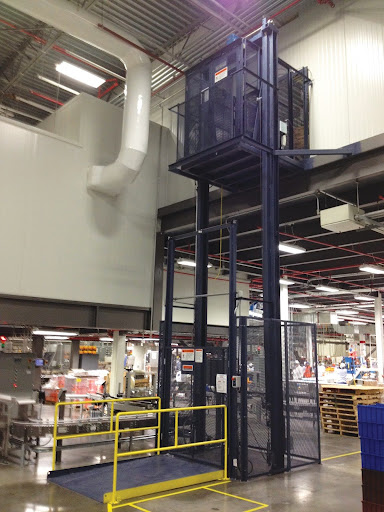 5 Reasons Why the PFlow M Series Mechanical VRC is the Ultimate Vertical Material Lifting Solution
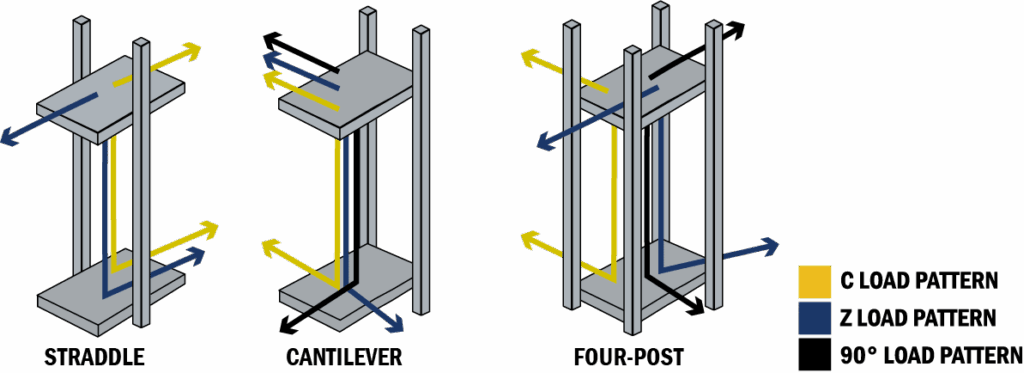 Mechanical VRC Comparison: Cantilever, Straddle, and Four-Post Configurations