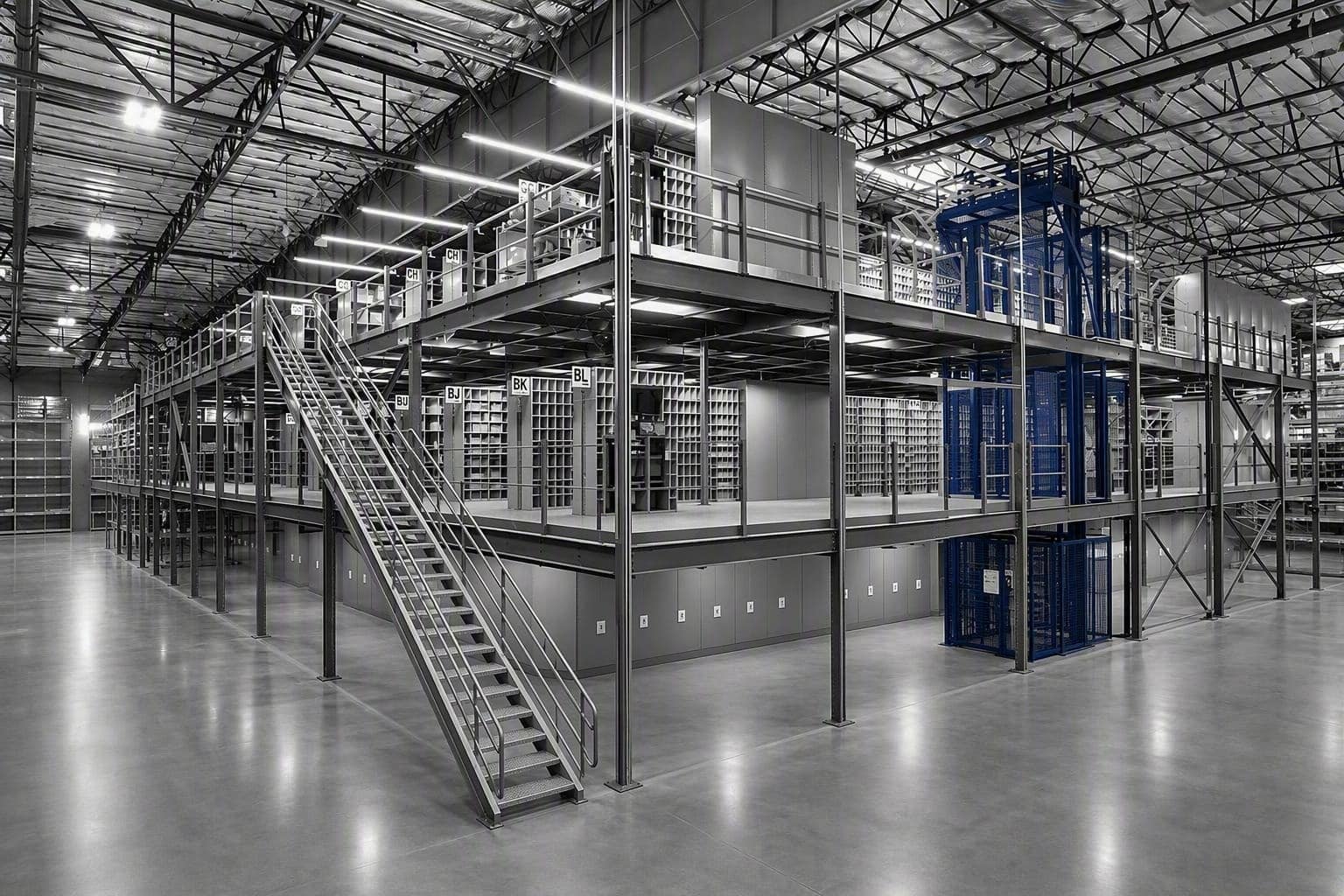
Moving materials between two levels in a warehouse is straightforward. A forklift, a sideloader, a hydraulic material lift for limited cycle lifting, or even an incline conveyor can handle the job without much complexity. But once a facility adds a third level, or a fourth, fifth, etc., the challenge changes fundamentally.
The Multi-Level Challenge
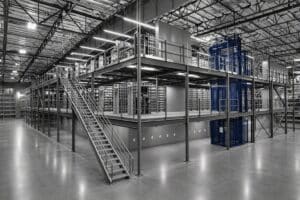
Multi-level warehouses and distribution centers are increasingly common, driven by rising real estate costs and the need to maximize cubic space utilization. Research consistently shows that many warehouses use only 50% of their available cubic capacity, even when floor utilization is at 80% or higher. (NetSuite, iGPS, Maveneer). The result is a growing number of facilities that store inventory across three, four, or more levels using mezzanines, multi-tier pick modules, and high-rise racking structures.
The problem is that while storage has gone vertical, many facilities are still relying on methods designed for two-level operations to move materials through these taller environments. The gap between vertical storage capability and vertical transport capability creates bottlenecks, safety risks, and labor inefficiencies that compound as the number of levels increases.
Why Traditional Methods Fall Short Beyond Two Levels

Forklifts
Forklifts are the default tool for vertical material movement in most warehouses, but they have significant limitations in multi-level applications. Standard forklifts have a maximum lift height which is typically around 15 to 20 feet for conventional models. Reaching higher levels requires specialized (and more expensive) equipment. More importantly, forklift-based vertical movement ties up both a piece of equipment and an operator for each trip. In a three- or four-level facility, a single pallet movement can require multiple minutes of forklift time, plus the travel between ramp access points or between levels.
The safety picture also changes at height. OSHA data consistently identifies forklifts as one of the leading sources of serious workplace injuries, and the risks increase when operating at elevated heights, on ramps, or in congested multi-level environments.
Hydraulic Lifts
Hydraulic lifts can be an effective solution for two-level applications with moderate cycle requirements. But they have limitations that make them unsuitable for multi-level operations. Most hydraulic VRCs are limited to approximately 22 feet of travel–enough for two levels but not three. They’re also limited to roughly 10 cycles per hour and 100 cycles per day, which can be a constraint in facilities with continuous material flow. For operations that need to move materials across three or more levels on a sustained basis, hydraulic lifts simply aren’t built for the job.
Freight Elevators
Freight elevators can handle multi-level movement, but they come with significantly higher acquisition, compliance, installation, and lifetime cost of ownership costs. Because elevators are designed to carry people, they’re subject to more stringent code requirements, more frequent inspections, and higher ongoing maintenance obligations. For facilities that only need to move materials (not people) between levels, a freight elevator often represents a substantial over-investment.
Incline Conveyors
The M Series Mechanical VRC: Built for Multi-Level Operations
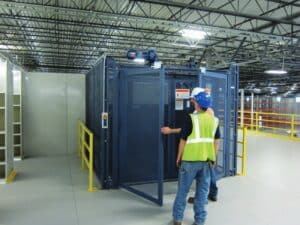
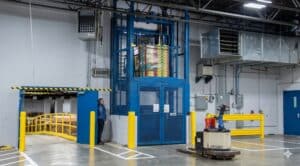
The PFlow M Series Mechanical VRC is a two-post vertical reciprocating conveyor engineered specifically for the kind of continuous, multi-level material movement that other methods struggle with. Unlike hydraulic lifts, the M Series has no limit on vertical rise. It can serve three, four, five, or more levels within a single system. And unlike forklifts, it operates continuously without tying up operators or mobile equipment.
How the M Series Works
The M Series uses a mechanical chain-driven system powered by electric gear drives to raise and lower a platform between levels. The platform, which is available in sizes up to 12 feet wide by 10 feet long, has a standard load capacity of 10,000 pounds, accommodating full pallets, loaded carts, and oversized items.
The mechanical drive system is what enables the M Series to operate without the cycle limitations of hydraulic alternatives. There are no hourly or daily cycle restrictions, which means the lift can run continuously across multiple shifts. Travel speeds start at 25 feet per minute and can be configured up to 400 FPM for high-throughput applications.
Multiple stopping positions can be programmed across the full travel height, so a single VRC can serve every level of a multi-story facility. Loading and unloading can be configured in C-pattern, Z-pattern, or 90-degree arrangements at each level, allowing the VRC to integrate naturally with different floor layouts at different heights.
Key Advantages Over Alternatives
Efficiency
A dedicated VRC eliminates the round-trip forklift travel, ramp congestion, and operator wait times that characterize forklift-based multi-level movement. Materials are loaded at one level and delivered to another without requiring a forklift or operator to travel with the load. In high-throughput facilities, this translates directly to faster material flow and reduced labor hours per unit moved.
Safety
Every M Series VRC includes interlocked gates, emergency stops, limit switches, and safety cams that prevent unintended carriage descent. Optional safety features like the DeckLock™ Safety System, safety enclosures, light curtains, and overload scales can be added based on application requirements. Because VRCs are classified as conveyors under ASME B20.1 (not elevators) they move materials, not people, and carry distinct code requirements that often provide more installation flexibility and lower compliance costs.
By removing forklifts from multi-level lifting duties, facilities also reduce the overall volume of forklift traffic on the floor, one of the most effective ways to lower the risk of collisions, tip-overs, and pedestrian injuries.
Reliability
The M Series mechanical drive system is designed for continuous, high-cycle operation. With fewer hydraulic components to maintain (no fluid, no seals, no cylinders) mechanical VRCs typically have lower long-term maintenance requirements. PFlow engineers each lift around the specific demands of the application, ensuring that the drive system, chain, guides, and structure are all sized for the actual loads and cycle frequencies the lift will encounter.
Maximizing Vertical Space Utilization
One of the most significant but underappreciated benefits of deploying VRCs in multi-level facilities is that they enable the facility to actually use the vertical capacity it has built. A warehouse can invest in multi-tier racking, mezzanines, and elevated pick modules, but if the vertical transport system can’t keep materials moving efficiently between those levels, the upper floors become underutilized or create workflow bottlenecks.
The M Series occupies a relatively small footprint compared to the floor space consumed by ramps, incline conveyors, or freight elevator shafts. A two-post mechanical VRC can be positioned adjacent to racking structures, integrated into pick modules, or installed in purpose-built shafts without consuming valuable storage or aisle space.
This footprint efficiency becomes increasingly important as the number of levels grows. A forklift ramp serving four levels requires substantially more floor area than a VRC serving the same levels, and that floor area could otherwise be used for storage, staging, or processing.
Real-World Applications
High-Rise Distribution Centers
Multi-Level Manufacturing Facilities
Manufacturing plants with operations spread across three or more floors use VRCs to move raw materials, work-in-progress, and finished goods between production areas. Because the M Series is engineered to order, it can be customized with specialized features for specific environments—including wash-down finishes for food processing, explosion-proof components for chemical handling, or stainless steel construction for pharmaceutical applications.
Automated Warehouses
In facilities using conveyor systems, AGVs, or AMRs, the M Series serves as the vertical bridge that extends horizontal automation across multiple levels. The lift integrates with PLCs, HMIs, and warehouse management systems, allowing fully automated material flow without manual intervention at the vertical transition points. Mobile robots can load and unload the VRC directly, maintaining uninterrupted material flow through the entire facility.
Vertical Cube Utilization Projects
Facilities that are growing up instead of out to avoid the cost of expanding their building footprint rely on VRCs to make the additional vertical capacity operational. Adding a mezzanine doubles available floor space, but only if materials can move to and from that mezzanine efficiently. The M Series provides the dedicated vertical transport that makes these expansions practical.
The Hidden Cost of Under-Investing in Vertical Transport
One pattern worth noting: facilities often invest heavily in vertical storage capacity with equipment like mezzanines, multi-tier racking, elevated platforms; but they often underinvest in the vertical transport systems needed to keep those levels productive. The result is a facility with ample storage space on paper but persistent throughput constraints because materials can’t move between levels fast enough.
When evaluating a multi-level facility design, it’s worth calculating the total vertical transport demand across all levels, not just the peak demand at any single point, and comparing that against the capacity of the planned transport method. Facilities that do this calculation often discover that their forklift-based plan would require dedicating multiple forklifts and operators full-time to vertical movement, at which point a purpose-built VRC delivers both better performance and lower total cost of ownership.
PFlow: The Authority in Multi-Level Material Lifting
As the founder and leading manufacturer of vertical reciprocating conveyors, PFlow Industries has spent decades solving the most complex vertical material handling challenges across virtually every industry. Every M Series VRC is custom engineered around the specific demands of the application: Load weight, travel height, cycle frequency, environmental conditions, integration requirements, and more. The result is a solution designed not just to work, but to work continuously and reliably for years.
Whether your facility is adding levels to an existing building, designing a new multi-story distribution center, or looking to replace forklift-based lifting that can no longer keep pace with demand, PFlow’s engineering team can help you design the right vertical transport solution.
Ready to solve your multi-level lifting challenge? Contact PFlow Industries to discuss your specific application or request a personalized quote.