In a modern warehouse or distribution centers, materials don't just move horizontally, they move up. Inbound freight needs to reach upper-level storage. Pick modules require continuous replenishment to keep orders flowing. And pack & ship areas need a steady supply of materials to avoid bottlenecks in the final stages of fulfillment.
At each of these points, vertical material movement is either a seamless part of the workflow, or it's slowing it down.
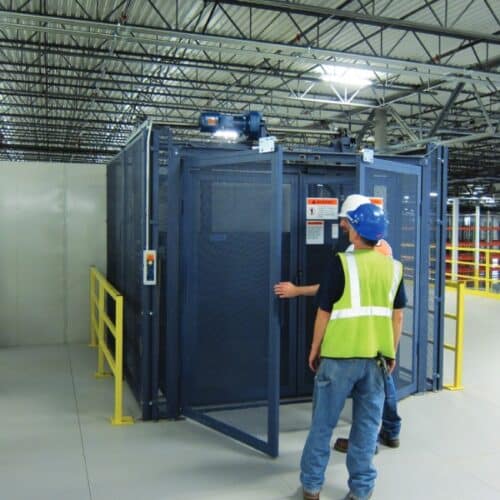
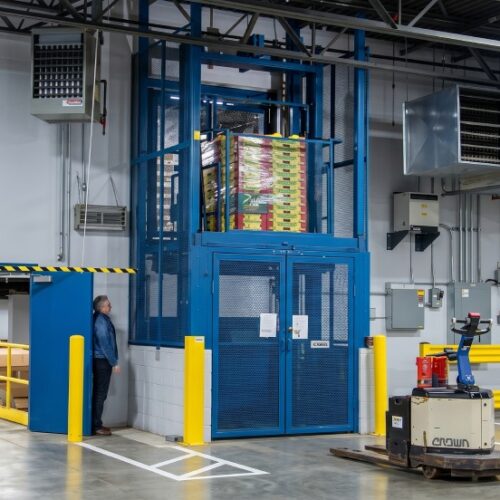
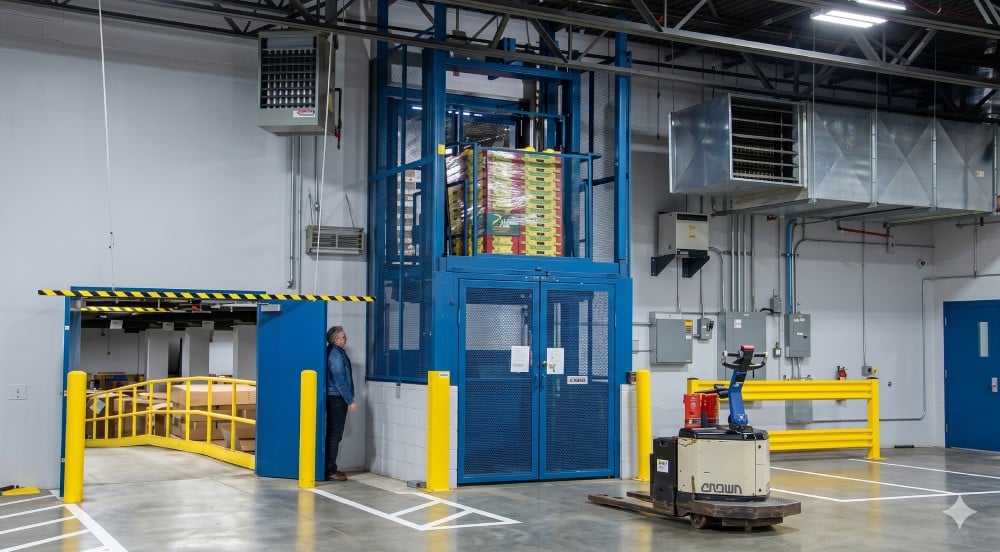
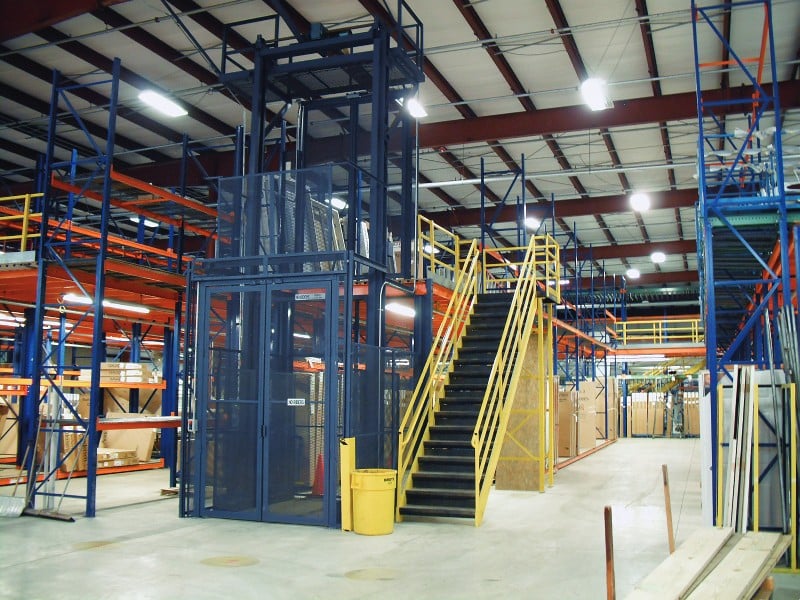
PFlow's M Series Mechanical Material Lift is a two-post vertical reciprocating conveyor (VRC) engineered for the demands of continuous warehouse operations. With standard load capacities up to 10,000 pounds, unlimited vertical rise, and unlimited cycle capability, the M Series is built for facilities where vertical material flow is constant, not just occasional.
What makes the M Series especially valuable in warehouse and distribution center environments is its versatility. Rather than solving a single vertical lifting problem, the M Series can serve as the vertical backbone connecting multiple stages of a facility’s workflow, from the time freight arrives at the dock to the moment a finished order leaves the building.
Understanding Vertical Material Flow Across the Warehouse
Most warehouse operations guides focus on horizontal layout: where to place docks, how to arrange aisles, and how to minimize travel distance. But for multi-level facilities, especially those using mezzanines, pick modules, or multi-story racking, the vertical dimension is often where the biggest efficiency gains (or losses) occur.
Consider the typical path materials take through a distribution center:
- Inbound receiving: Freight arrives at the dock and needs to reach upper-level storage areas, reserve inventory zones, or bulk storage on a mezzanine.
- Pick module replenishment: Inventory stored in reserve areas must continuously feed active pick locations across multiple levels to keep order fulfillment moving.
- Order staging and shipping: Completed orders and packing supplies need to move between floors for final processing, including scan, label, apply, and manifest (SLAM) operations.
Each of these stages involves a vertical transition. And every time materials need to change levels, you’re relying on a purpose-built vertical transport system or you’re improvising with forklifts, scissor lifts, or manual carrying. The difference has a direct impact on throughput, safety, and labor costs.
Identifying Your Vertical Bottlenecks: A Touchpoint Approach
One of the most effective ways to evaluate whether your facility needs a VRC, or additional VRCs, is to map every point in your operation to determine where materials change elevation. These are your vertical touchpoints, and most facilities have more than they realize.
A vertical touchpoint occurs anytime a pallet, cart, tote, or container needs to move from one level to another. To audit your own facility, walk the path a typical order takes from dock door to outbound shipping and count each elevation change. Then note:
- How is each transition currently handled? Forklift? Stairs? Ramp with a hand truck? Incline conveyor? Existing lift?
- What is the cycle frequency at each point? Is it a few loads per hour, or a continuous stream?
- What’s the load profile? Full pallets? Individual cartons? Mixed loads on carts?
- Is there waiting or queuing at any of these points? A line of pallets waiting for a forklift to carry them to a mezzanine is a measurable bottleneck.
This exercise frequently reveals that facilities are making far more vertical transitions than they assumed. Usually two or three high-frequency touchpoints are responsible for a disproportionate share of delays and labor hours. These are the points where a purpose-built VRC delivers the most immediate return.
A facility might discover, for example, that the vertical transition between bulk reserve storage and pick module levels accounts for dozens of forklift trips per shift, each one tying up both a forklift and an operator for a task that a mechanical VRC could handle continuously and without operator involvement.

Inbound Receiving: Getting Freight Where It Needs to Go
The warehouse workflow begins at the dock. As inbound shipments are unloaded, verified, and staged, they need to move into storage; in a multi-level facility, that often means moving up.
Many facilities rely on forklifts to transport pallets from the receiving area to upper-level storage. This works, but it creates a series of inefficiencies: forklifts are shared resources, operators must travel between levels (often on ramps or via freight elevators), and the process creates traffic congestion on the warehouse floor.
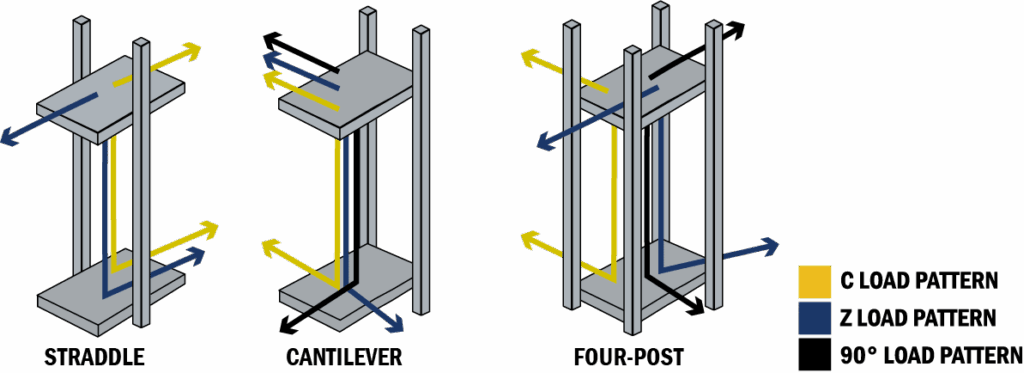
An M Series VRC positioned near the receiving area provides a dedicated vertical path for inbound freight. Pallets can be loaded at dock level and sent directly to upper-level storage without tying up a forklift for the full round trip. Because the M Series supports multiple loading patterns, including C-pattern, Z-pattern, and 90-degree loading, it can be configured to fit naturally into your existing dock layout and traffic flow.
For facilities processing high volumes of inbound freight, this can substantially reduce the time between dock arrival and storage availability, which in turn accelerates the speed at which new inventory becomes available for order fulfillment.
Pick Module Replenishment: Keeping Orders Moving
Pick modules are where order fulfillment speed is won or lost. When active pick locations run low on inventory, orders slow down. When they run out, orders stop. The challenge in any multi-level pick module is getting replenishment inventory from reserve storage to active pick locations quickly enough to prevent these gaps.
This is one of the most common and highest-value applications for the M Series VRC. Because pick module replenishment is a high-frequency process, it requires a vertical transport solution that can handle unlimited cycles without degradation in performance. Hydraulic lifts, which are limited to approximately 10 cycles per hour and 100 cycles per day, simply can’t keep pace with the demands of an active pick operation. The M Series has no such limitation.
VRCs can be positioned within or at the ends of pick module structures, creating dedicated replenishment lanes that don’t interfere with picking activity. In automated environments, the M Series integrates with conveyor systems, PLCs, and warehouse management systems (WMS). This helps establish fully automated replenishment flows, where inventory moves from reserve storage to pick locations without manual intervention at the vertical transition point.
The M Series also supports integration with AGVs and AMRs, allowing mobile robots to load and unload the VRC directly. This extends horizontal automation into the vertical dimension, an increasingly critical capability as facilities adopt more robotic systems.
The Last 100 Feet: Supporting SLAM and Outbound Operations
The final stage of warehouse fulfillment (often called the “last 100 feet”) is where picked orders are scanned, labeled, manifested, and prepared for shipment. Known in the industry as SLAM (Scan, Label, Apply, Manifest), this area is where throughput bottlenecks are most costly because every delay directly impacts delivery commitments.
SLAM operations require a constant flow of packing supplies, shipping materials, and completed orders moving between levels. High-volume SLAM areas can contain dozens of processing stations working in parallel, and each station must be continuously stocked. When the SLAM area is on a different level than picking or supply storage, vertical material flow becomes a critical link in the chain. PFlow has covered this topic in depth, explaining how VRCs fit into your warehouse SLAM area.
The M Series is well-suited for this application because of its speed and cycle flexibility. Standard travel speeds of 25 feet per minute are available, with configurations up to 400 FPM for high-throughput operations. Combined with unlimited cycle capacity, the M Series can keep pace with the sustained demand of a busy SLAM operation without the downtime or cycle limitations of hydraulic alternatives.
Why the M Series Is Built for Warehouse-Wide Deployment
The applications described above (receiving, replenishment, and outbound staging) are distinct operational challenges, but they share common requirements. Each demands a vertical transport solution that can operate continuously, handle heavy loads, and integrate with existing systems and workflows. The M Series addresses all three because it was designed for exactly this kind of demanding, high-frequency environment.
Key M Series specifications that support warehouse-wide deployment include:
- Standard load capacity up to 10,000 lbs: Handles full pallets, loaded carts, and heavy inventory with ease.
- Standard carriage size of 12’ x 10’: Accommodates standard pallet sizes and oversized loads.
- Unlimited vertical rise: Serves any number of floor levels, from a single mezzanine to multi-story facilities.
- Unlimited cycles: No hourly or daily cycle restrictions, enabling 24/7 operation.
- Travel speeds up to 400 FPM: Configurable for both standard and high-speed applications.
- Indoor and outdoor use: Hot-dipped galvanized or epoxy finishes available for outdoor or wash-down environments.
- Automation-ready: Integrates with conveyor systems, PLCs, HMIs, WMS platforms, AGVs, and AMRs.
Because every PFlow VRC is engineered to order, the M Series can be configured differently for each deployment point within the same facility. A receiving-area VRC might be optimized for heavy pallet loads with C-pattern loading, while a pick module VRC in the same building could be configured for lighter, higher-frequency replenishment cycles with conveyor integration. This flexibility is central to the M Series’ value as a system-wide solution rather than a single-purpose tool.
Built-In Safety for Every Application
Warehouse environments present distinct safety challenges at every stage of the workflow. Inbound areas have heavy loads and high forklift traffic. Pick modules involve workers at elevation. SLAM areas combine speed with density. The M Series is built with safety features that address these concerns across all applications.
Standard safety features on every M Series VRC include interlocked gates, emergency stops, chain sensors, limit switches, and certified safety cams that prevent carriage descent in the unlikely event of a chain failure. Optional enhancements like the DeckLock Safety System, safety enclosures, and light curtains can be added based on each application’s specific requirements.
Because VRCs are classified as conveyors under ASME B20.1, not elevators, they have distinct code requirements that often provide more installation flexibility and lower ongoing compliance costs compared to freight elevators.
Build Vertical Efficiency Into Every Stage of Your Workflow
The most efficient warehouses don’t treat vertical material movement as an afterthought. They build it into their operational design from the start, and when they expand, they add vertical capacity alongside horizontal capacity.
Whether you’re looking to improve inbound receiving flow, eliminate pick module replenishment delays, or keep your SLAM area running at full speed, the PFlow M Series Mechanical VRC is engineered to deliver reliable, continuous vertical material movement in the most demanding warehouse environments.
Ready to evaluate your facility’s vertical material flow? Contact PFlow Industries to discuss your specific application or request a personalized quote.
 How the Cost of a PFlow M Series Mechanical VRC is Determined
 Mechanical VRC Comparison: Cantilever, Straddle, and Four-Post Configurations